Happy 200th Birthday Darwin!
 A friend sent a "Darwin Birthday Letter" this morning and urged us all to celebrate life today, in honor of Charles Darwin, THE evolutionary biologist!
A bit silly, but I urge you to do the same!
Celebrate Life!
 A friend sent a "Darwin Birthday Letter" this morning and urged us all to celebrate life today, in honor of Charles Darwin, THE evolutionary biologist!
On May 20, 2008, Iceland announced that it would allow 40 minke whales to be killed over the next six months. This is in open defiance of the commercial whaling ban that the International Whaling Commission (IWC) implemented in 1986, and a reversal of the country's decision in 2007 to halt this brutal practice.
There is no need for whaling. Only 17% of Icelanders would even eat whale meat (and with the number of whales they want to kill, each Icelander would have to eat 4 elephants worth of meat next year!!). And modern products are far superior to whale-made products. For more information about Icelandic whaling, please click here.
Besides, these animals are still endangered!! And they're facing enough problems (pollution, global climate change, etc.) without being brutally attacked by humans!
So, I ask you to take 2 minutes and write to Iceland’s fisheries minister, Einar Kristinn Guðfinnsson, and tell him you disagree with his decision to hunt whales! Just click here!
I just got an email that one of my papers was cited in another paper.
This happens to famous scientists every day, I am sure. (Like RyGuy and his book citations)
But I get just a bit excited when it is my paper that gets a citation! That means someone actually read my paper!!!!! And not just read it, but thought it was important enough to mention in their paper! And it's not even someone I know (usually my citations are by collaborators)!
A sad little highlight of my science-filled life!
So ... it's a bit hard to read ... but, trust me, it's worth the eye strain!
Did you know that in 1975 Congress passed the Metric Conversion Act??

 When the dolphins take over the world, I hope they remember me as their friend.
Dolphins & The Navy
Is the water near Seattle too cold for bottlenosed dolphins? It was a bit chilly for me during the summer months. And I'd say my blubber distribution is near equivalent to a dolphin's.
(Photo by Ry, summer 2006, 2 of my favorite dolphins)
Check out this link that the professor's in my department are sending around.


Thanks!
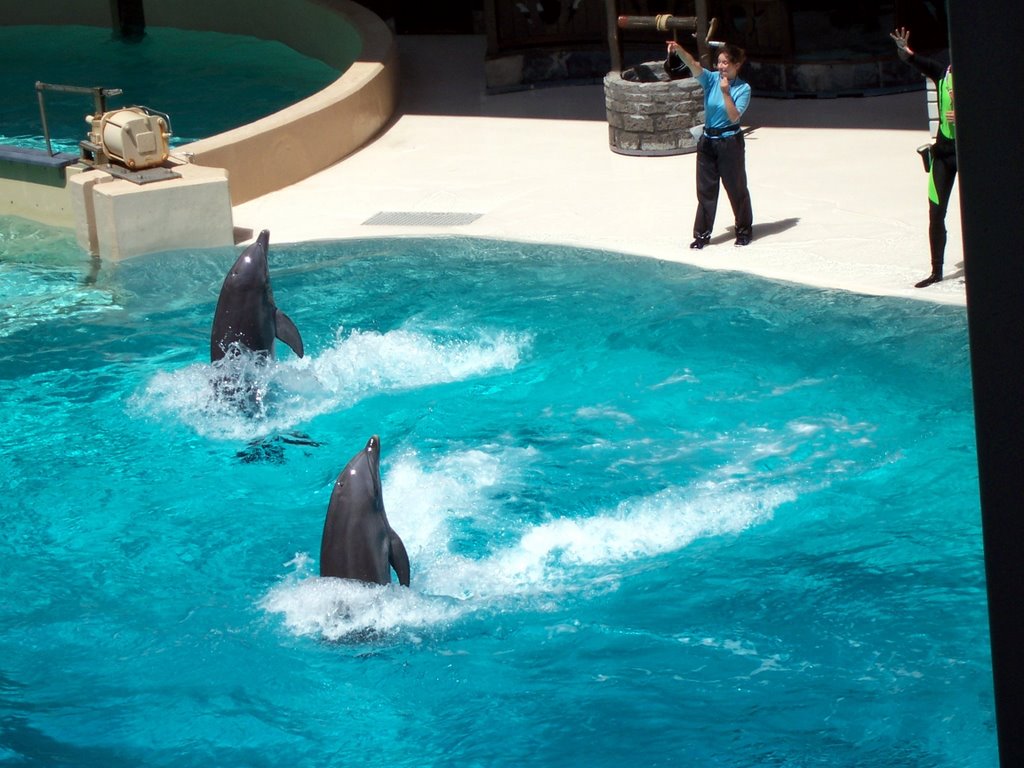 Some dolphin news for you!
As a known whale hugger, I am often asked questions about whales (if you have any, please feel free to post them to me).
One that I have no good answer for is "Why do whales strand themselves on beaches?". No one really has a good answer to this. Could be an infection that affects their echolocation and leads to stranding. Could be loud radar noises that interfere with their navigating. Could be that one or many of the whales are sick and the whole pod strands. Or maybe the whales just want a margarita, so they head to the beach. There just hasn't been enough scientific research to really understand the cause of the strandings. And once we know the cause, we might be able to prevent the strandings somehow.
But, sadly, today marked the first pilot whale mass stranding of the summer season in New Zealand. Pilot whales tend to strand more often than other species and numerous strandings are reported each year up and down the New Zealand coast.
As a scientist, conservationist, and whale-hugger, I urge you to learn more about whales and contribute to research programs that study whales (such as The Whale Museum Research Program, The Center for Whale Research, The CRCC, the WWF, or the Animal Behavior Society's Cetacean Research Grant Program). With the governmental funding agencies being so tight with money lately, it is difficult to receive grants for research -- especially whale behavior research which probably will not cure cancer. Probably.